Photo of The Day

Short stories about traveling to interesting places

17/04/14

Phu Quoc Island. Vietnam.

This peaceful tropical paradise, floats in the warm turquoise waters in the Gulf of Thailand, 50kms from the Vietnamese mainland and a 50 minute flight from Ho Chi Minh City (Saigon). Open year round with a peak season from November to March, Phu Quoc is becoming well known for stunning beaches, untouched natural environment, the easy going and relaxed atmosphere, friendly locals, and fantastic food. The majority of Phu Quoc Island is dedicated to National Park and protected marine environment, providing a memorable experience, with plenty of exciting activities and places to visit. For the best down to earth shopping and life style experience, visiting the local markets on the island is highly recommended. While western style goods are very limited, the local markets offer a colourful range of fruit, vegetables, seafood’s and much much more. Duong Dong market located in the centre of town along the river is the islands largest and most exciting local market. At most times of the day this can be a busy place with the local traffic running along the road and boats coming and going, loading and unloading their goods, and it is here you will find lovely ladies in conical hats selling everything from tropical fruits to unusual fishing equipment. If enjoying a colorful decent crowd is your thing, I strongly recommend Duong Dong market when cruise ships arrive (usually once a week) at the pier, bringing thousands of travellers, who fill the town and market place. I you have luck, you will shot a nice photo like this one.

11/04/14

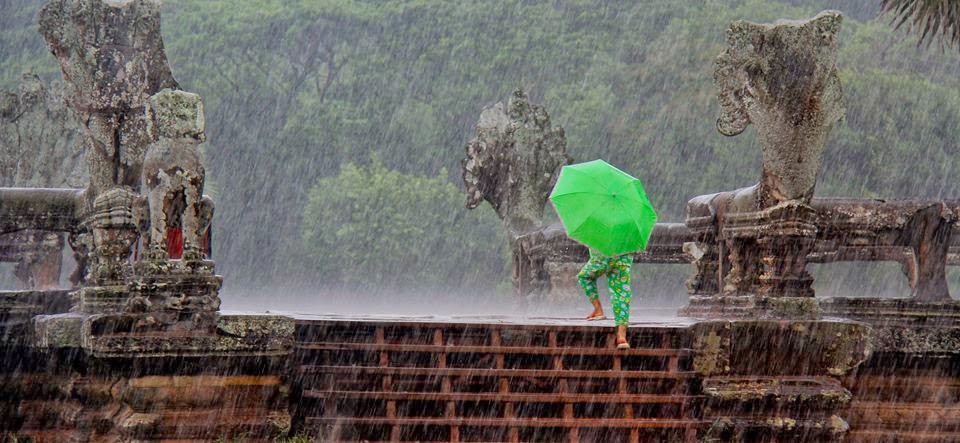
“Still living in”. Angkor Vat. Cambodia.

Angkor is one of the most important archaeological sites in South-East Asia. Stretching over some 400 km2, including forested area, Angkor Archaeological Park contains the magnificent remains of the different capitals of the Khmer Empire, from the 9th to the 15th century. They include the famous Temple of Angkor Wat and, at Angkor Thom, the Bayon Temple with its countless sculptural decorations. The Angkor complex encompasses all major architectural buildings and hydrological engineering systems from the Khmer period and most of these “barays” and canals still exist today. All the individual aspects illustrate the intactness of the site very much reflecting the splendor of the cities that once were. Angkor is one of the largest archaeological sites in operation in the world and UNESCO has set up a wide-ranging programme to safeguard this symbolic site and its surroundings. Tourism represents an enormous economic potential but it can also generate irreparable destructions of the tangible as well as intangible cultural heritage. Visiting Angkor complex is a life time experience, for its beauty and for the history. Tourism seams to appear in all forms! In a back of an elephant, in a tuck-tuck ride, crowds expecting the wonder of the sunset, sleeping face admiring the sunrise over the stupas. But! Are we paying attention to all the details? Do we really see everything? What about people who lived within the Angkor Wat enclosure. Do we think about their feellings? Many people may not know that when the French first began to do research and conservation at Angkor Wat that there were Buddhist monks living very close to the main temple entrance. In fact, there are actually two Buddhist Wats within the Angkor Wat enclosure, called Wat Cheung (northern wat) and Wat Tbong (southern wat). In my visit to Angkor in 2013, while admiring this important archaeological site, I realize the importance that those faces had to me. No meter the fact that they are the workers working on the restoration of the site or just children playing, or making a living for a few dollars from the tourists, they were the true meaning of “my” Angkor Vat. Of course, having people live close to heritage sights can create many tricky issues. But they are part of this magnificent place, and we must respect that. This is the experience I wanted to share with my photos too.

26/07/13

In the laps of the days. Istanbul. Turkey.

I decided to publish a photo from Istanbul today. Just because I like it or I have a very good reason to do it. I felt that this photo is a part of me. This photo was taken in Istanbul, during the winter. I love Istanbul. I like this photo a lot: the city, the river, the human presence at the corner. It looks a little dirty, but still beautiful, a bit like Istanbul, itself. Istanbul is the city at the crossroads between Europe and Asia. Istanbul has lived through several empires and has a character that is marked by many layers of history – in this black-and-white image, the city’s melancholy aesthetic oscillates between tradition and modernity too. Sometimes we met in the chance of life, than we exchanged the laps of the days, we lose ourselves in the hours, we waited minutes senses, we lost the sense time. It’s a good feeling. Then, unexpectedly, we are touched by the word “missing”. A word difficult to define, but easy to feel. I think it is the most overwhelming feelings that exist. Is like a strong void. The silence. The absence. Like a piece that was taken from us. Time helped me to see the picture in perspective, explore the good parts of it, and keep it my memory.

19/07/13

People moves in the airport


People moves in the airport. They own their own destiny. I imagine the stories that terminate their lives. Passes a couple with holiday costume, tan, happy, certainly arriving from a warm place somewhere in the world. A group of executives are discussing serious themes nearby. Two young children play in the distance distract from everything around them. It seems to me that they are honest. Like them, I would be faithful to the truth that I know and that I believe. In life it may be ever so. Sincerity saved from us. If I am writing these words is because I am alive. Boarding begins. I enter into the plane. The plane takes off. I change the song. I choose "step", from Vampire Weekend. Happier. I relax a bit. I try to change to my book of José Luís Peixoto, who calls "inside the secret". Is the story of a secret trip to North Korea lived by him. I use it has an excuse to get in to track. I see in the distance a huge city by the window of the plane. I notice the coincidence - the title of the book – “Inside the secret” and I sketch a smile just for myself.

11/09/12

Portugal at the sea II


you don’t have to travel very far to find a quiet corner to enjoy the best surf and the harmony between man and nature just to yourself

03/09/12

Portugal at the sea


Somewhere in Portugal. In the traquility of a book, wainting for the waves.

02/11/11

Maximum Respect. Porters of Kilimanjaro. Tanzania

Anyone who has climbed Kilimanjaro will know what a huge role the porters played in the climb. About 20,000 climbers attempt to reach the top of Mount Kilimanjaro in Tanzania each year, the highest peak in Africa. Around 70 % of them succeed. Climbing high peaks can make people famous and admired. They get their names and photo in media. It also makes them admired among friends and colleagues. But who are the really heroes in this story? In all of my travelling experiences around the world, I have never experienced such enormous support to fulfill the final goal like in Kilimanjaro. I’ve always been impressed by guides and carriers for their strength, endurance and dedication. I’ve been assisted in jungles, deserts, some very hot valleys but nothing when compared with the porters at Kilimanjaro. These are the real heroes of Kilimanjaro, the ones that makes the magic appear in the summit night. When I reach the top on the 30th June 2011, I remember standing on top of Kilimanjaro in a sea of clouds and snow and watching curious but in a funny way the porters who had accompanied us to the top muscled in on summit photos, grabbing cameras to record our happy moment. These guys do this as a job. They spend six days on the mountain, climbing in ragged clothes and shoes with 25 kg on their head and back. After you set out in the morning they pack up your tent and all the other equipment, they race past you to set everything up again at the next camp (for lunch also), they help the cook, do the dishes, serve your dinner, carry all the water from the nearest stream, boil it so you can have a hot wash and fill your bottles for the next day. Each day on the mountain is a struggle for life. Porters also carry another big task: they take care of the climbers` life, the big responsibility among all. So, the thing is…If we get to top is because this guys are hard workers and are there to help us. Symbolically I pray here my best respect to them all and loudly I say: MAXIMUM RESPECT.